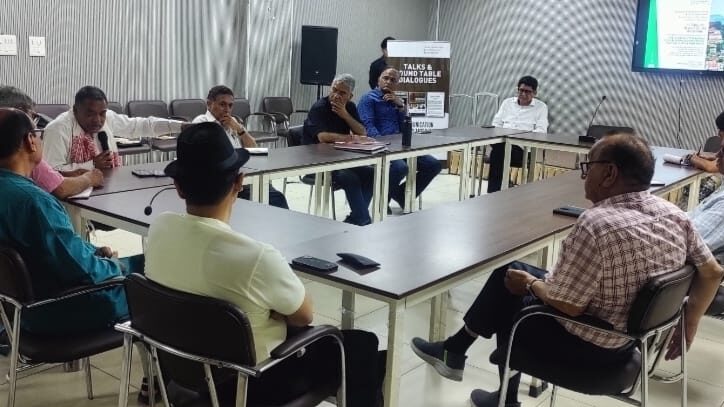
SDC Foundation organized a thought-provoking roundtable dialogue at the Doon Library, bringing together journalists, activists, civil society members, and domain experts to reflect on the pressing issues facing Uttarakhand. The dialogue, titled “The Future of Uttarakhand: Social, Economic, Political, and Environmental Changes and Their Impact”, offered a platform for candid discussions and critical reflections.
The session was initiated by Chandra Shekhar Tiwari from Doon Library and set the stage for an engaging and often sobering exchange of ideas.
Senior journalist and activist Rajeev Nayan Bahuguna opened the discussion by expressing concern over a “dangerous silence” engulfing Uttarakhand’s society. He warned that while there are voices trying to break this silence, many are, in fact, exacerbating the situation. He emphasized that the responsibility of initiating genuine change lies with those who are not driven by political self-interest.
Veteran journalist Jaysingh Rawat spoke on the contentious issue of land law reforms, asserting that what is currently being portrayed as reform is, in fact, a calculated move to provoke public sentiment. He criticized the use of terms like “outsider,” calling them unconstitutional and detrimental to the legitimate fight for land settlement rights.
Former Principal Chief Conservator of Forests, Jai Raj highlighted the increasing levels of corruption within government departments and the state’s growing disconnect from civil society. He stressed the need for a credible political alternative, pointing to the difficulty citizens face in accessing even basic public services without the expectation of personal favors.
Adding a regional dimension, social worker Jagmohan Mehandiratta flagged the growing rift between Uttarakhand’s hill and plain areas. He noted that regionalism is being exploited as a shortcut to political gain. Ranbir Chaudhary, another social activist, expressed concern over the large-scale land transfers in the state, criticizing the lack of transparency in related data from government departments.
Ratan Aswal, who works extensively in rural development and migration prevention, underscored the need to create sustainable employment, particularly in the tourism and horticulture sectors, as a means to curb out-migration.
Journalist Pawan Lalchand emphasized that the plains are an integral part of Uttarakhand, yet often remain sidelined in mainstream narratives. He brought attention to the ongoing struggles of farmers in areas like Narsan in Haridwar district. Echoing a similar sentiment, journalist Yogesh Kumar called for the creation of strong pressure groups to represent diverse voices in the state.
Activist Trilochan Bhatt expressed concern about the increasing influence of communalism and regionalism, warning that these trends are being systematically encouraged.
In his concluding remarks, Anoop Nautiyal of SDC Foundation addressed the alarming environmental degradation in Uttarakhand. He cited the unregulated nature of the Char Dham Yatra as a major example of neglecting ecological limits, particularly in the absence of carrying capacity assessments. He also drew attention to rising unemployment, deteriorating law and order, and political stagnation.
Anoop made a heartfelt appeal to Uttarakhand’s intellectuals, youth, and women to step forward and actively participate in shaping a better future for the state.