“We are the people who live in the forest. We want rights over our land and forest for our development, and we want to participate equally in it.”
– Rajwar elder woman from Kimkhola village, Pithoragarh, Uttarakhand
The room fell silent as a Rajwar elder woman took centrestage. Her weathered hands gripped the microphone with quiet steadiness. When she began to speak of the forestland her ancestors had tended for generations—land she no longer felt secure on—her voice carried the weight of collective memory. Across the stage, district officials leaned forward, listening intently.
This wasn’t a protest. It wasn’t a plea. It was something entirely different.
On October 10, in a gathering that redefined what community engagement can look like, the Rajwar people—a Particularly Vulnerable Tribal Group (PVTG) known as Van Rajis—took the stage to tell their own story. The seminar, “Hamari Kahani, Hamari Jubani” (Our Story, Our Voice), was not just about them. It was by them and for them—a demonstration of what happens when Indigenous communities are given the platform they have always deserved but rarely received.
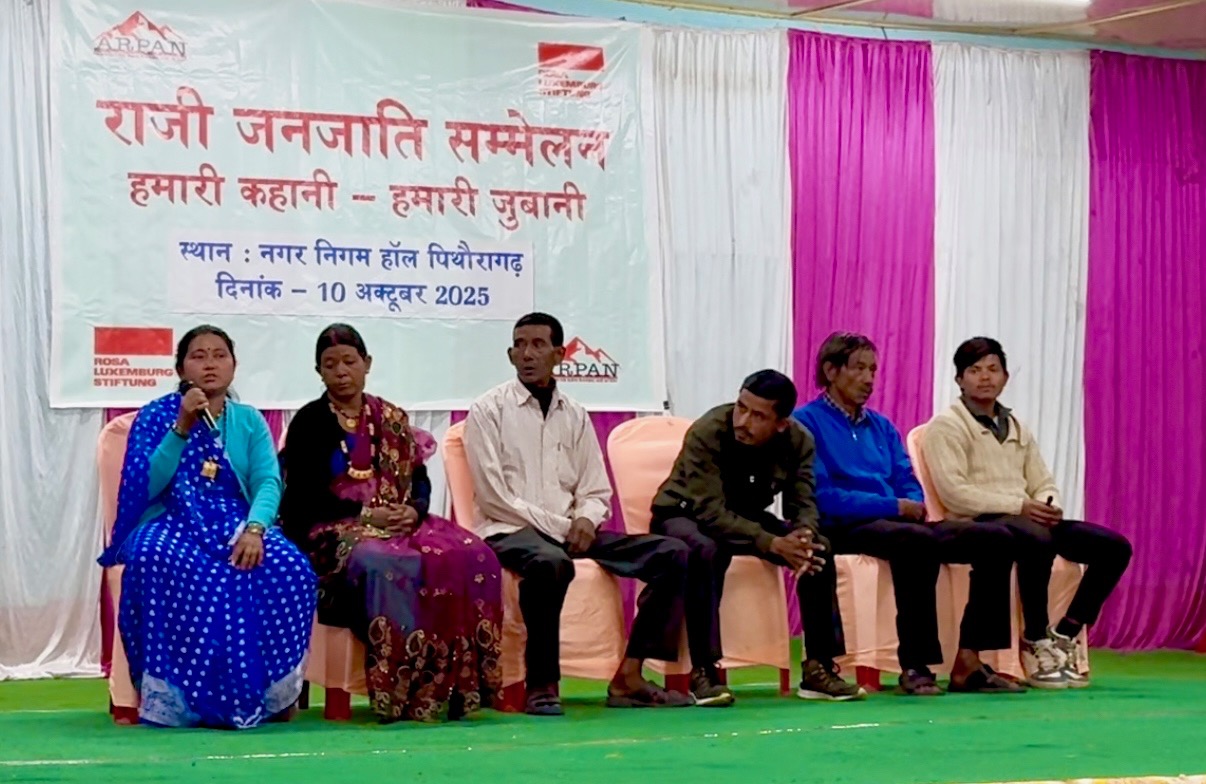
With support from the Association for Rural Planning and Action (ARPAN) in partnership with Rosa-Luxemburg-Stiftung (RLS) South Asia, the seminar brought together an intergenerational cross-section of the Rajwar community from ten villages of Uttarakhand—women and men, youth and elders—alongside senior district government officials, including the District Magistrate and District Forest Officer. Yet, the usual hierarchy of such meetings was deliberately inverted: the microphone belonged first to the community.
Ms. Renu Thakur, Chief Operating Officer at ARPAN, shared:
“We brought this platform to the Van Rajis so they could share their developmental issues directly with government officials. This wouldn’t have been possible without the support from RLS.(…) The main objective of this seminar is to support the Raji tribe in their collective leadership, where they will share their journey in their own way and voice their concerns on their struggles, challenges and how they view their future. An opportunity to sensitize all concerned to view them as partners in development and not as beneficiaries”
This sentiment was echoed by Mr. Vinod Koshti, Project Manager at RLS South Asia:
“RLS’s support to ARPAN has been fundamental in building a lasting bridge of trust with the Raji community. The powerful seminar we witnessed was the direct result of this years-long engagement. It created a platform where Raji voices could speak directly to power—with dignity and effect. (…) Our philosophy is one of solidarity, not imposition. We walk alongside the community, learning from their resilience and supporting their self-determined path forward. RLS is committed to being a co-traveller with the Raji people in their pursuit of justice, dignity, and self-reliance.”
What unfolded was remarkable in its clarity and conviction. One by one, Rajwar community members described the realities shaping their lives: forestland tenure security—the foundation of their livelihoods and cultural survival; access to basic health services; education for their children; and a right to development that does not erase their identity.
A Rajwar youth from Bhagtirwa village in Pithoragarh said:
“The Forest Rights Act came in 2006, directing that Rajis should be settled on their traditional lands. In 2018, 2020, and 2021, we received 83 land deeds (pattas). Now, we want to convert those deeds into ownership rights (Malikana Hak). On the deeded land, we neither receive compensation nor benefits from social security and tribal welfare schemes. If the land is converted into ‘Revenue Land’ (Rajaswa Bhumi), it will at least support our basic living needs.(…) There are so many families that have not received land rights yet, we want to work on that too.”
There was no hesitation in his voice, no apology—only assertion with simplicity. Similar concerns echoed across testimonies as community members demanded participation in land governance processes. They also raised issues concerning education, health, livelihood, employment, housing, and representation in local governance. Rajwar youth from Kimkhola village shared:
“We want to create our own gram sabha to discuss our issues. We are neither represented in the existing gram sabhas nor elected, as we often don’t meet the educational and two-child criteria. We request the government to relax these for the next 10–20 years so we can become eligible. Meanwhile, forming our own gram sabha will allow us to address community-specific issues.”
Currently, panchayat election eligibility requires an 8th-grade education and no more than two children—criteria that exclude most Raji members. In Kutachaurani village, for example, no woman could contest the reserved seat in the last election due to these restrictions. The community therefore demands temporary exemptions to ensure their inclusion.
The community also appealed for the integration of Raji villages under one gram sabha. Villages such as Ganagaon, Bhagtirwa, and Kimkhola, all in the Dharchula block, remain administratively divided between different village assemblies, weakening their representation. The Rajwar community's concerns about land security and equitable development aren't isolated issues—they're microcosms of challenges facing particularly vulnerable tribal groups across India.
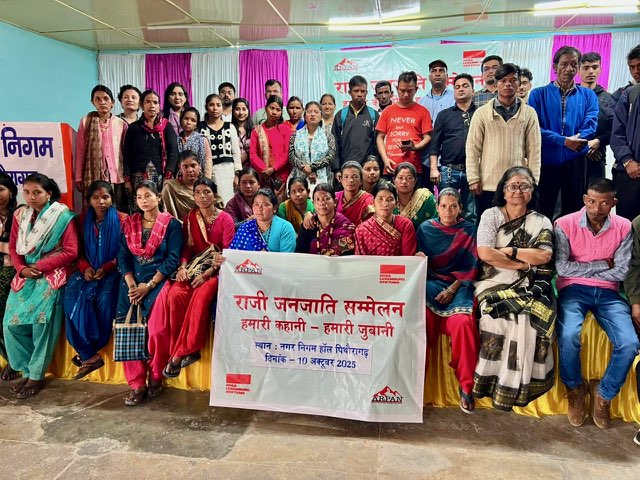
What could have been a perfunctory “community consultation” became something more. District officials didn’t merely attend—they engaged. The District Magistrate announced:
“We are ready to support the Van Raji community to the best of our ability. I’ve observed a lack of coordination among departments, and this must change. All departments—and indeed, society as a whole—must work together to support Raji development. NGOs, researchers, and activists all have a role to play in guiding the community’s growth.”
Similarly, the District Forest Officer assured:
“On behalf of the Forest Department, I assure you that the pending Forest Rights Act proposals will be acted upon as soon as possible, so that you may receive your rights.”
Their commitments were specific, not bureaucratic. Whether these promises translate into action remains to be seen, but the tone in the room suggested a shift—listening for genuine consultation and potential collaboration.
The seminar’s impact extends beyond that single October day. This marks the beginning of a new chapter in Indigenous engagement and development in Uttarakhand, India. Conversations that began in that room are now rippling outward: plans for capacity-building, collaborative research centering Rajwar perspectives, and efforts to bring their voices to national and international forums are underway. The Rajwar community has been invited to present their issues at the India Land Development Conference in Ahmedabad (November 17–20) and at a state-level seminar in Dehradun among government officials.
As the seminar concluded, there was no triumphant declaration of success. The Rajwar community’s struggles for tenure security and access to basic services will not end overnight. But something fundamental had changed—the terms of engagement.
The Rajwar people showed they don’t need others to speak for them; they need others to make space for their voices. They don’t need their stories translated; they need platforms that honor their words, perspectives, and priorities.
Hamari Kahani, Hamari Jubani was not just a seminar title—it was a declaration of ownership: over narratives, futures, and the right to define development on their own terms. When Indigenous communities articulate their needs with precision, when state officials respond with sincerity, and when civil society facilitates rather than mediates, we glimpse what true participatory governance can look like.
The Rajwar elder woman who opened her remarks that October morning lingered long after the gathering dispersed. The officials heard her. The question now is whether the systems they represent will listen just as intently.
Dr. Dipika Adhikari works with the Rajwar community to advance their developmental concerns. As part of her doctoral research at the Australian National University, she studied tenure issues among the Rajwar people. She now collaborates with ARPAN to support community-led development and well-being.

