Uttarakhand known as Devbhumi, the land of sacred rivers, ancient temples, and historic settlements has marked its silver jubilee on 9 November 2025. The state bears testimony to a prosperous and culturally rich past and therefore, its tangible heritage, including temples, archaeological sites, traditional and vernacular architecture, medieval forts, step-wells and inscriptions represents an invaluable cultural asset. However, despite their immense significance, these heritage properties remain among the most neglected aspects of the state’s cultural wealth. This neglect is not accidental; it arises from weak policy vision, administrative gaps, lack of documentation, frequent natural disasters, and unregulated construction around it.
Although the Department of Culture, Government of Uttarakhand, has made some efforts such as the listing of monuments, renovation of some temples and a few conservation projects under centrally funded schemes but these remain fragmented, without a coherent policy framework. The absence of a dedicated State Heritage Conservation Act and limited inter-departmental coordination have further weakened the implementation of any concrete conservation of monuments, temples and built architecture under its jurisdiction and control. As a result, even well-intended projects have failed to ensure long-term protection or scientific conservation of heritage assets.
While it is well understood that tangible heritage is irreplaceable, once a temple collapses or a historic house is demolished, it can never be reconstructed with the same authenticity, the state still seems to be moving in the wrong direction. These structures are not only symbols of faith but also embody the region’s architecture, settlement history, craftsmanship, and cultural philosophy.
As Uttarakhand celebrates its Silver Jubilee, this moment offers an important reminder that the region’s tangible heritage has supported local livelihoods long before statehood.
Continuing this legacy, over 23 crore tourists visited the state between 2022 and 2025, driving demand for heritage-based tourism. Nearly 3,600 registered homestays now support around 8,000 people in remote areas, while MSMEs in tourism and crafts employ more than 6.6 lakh individuals across the state.
It shows that, these historical structures significantly contribute to local economies through tourism, pilgrimage and homestays. They also reinforce the shared identity between the people and the land. Traditional architecture in stone, slate, and wood, evolved in harmony with the seismic Himalayan environment, represents a form of ecological wisdom that we are at risk of losing.
Despite these realities, Uttarakhand still lacks a dedicated state heritage conservation law. While a few sites are protected by the Archaeological Survey of India, hundreds of temples, shrines, forts, old houses and buildings, and water structures remain either have remained unprotected.
Unfortunately, we have reached a stage where much of the tangible heritage of Uttarakhand survives not because of strong policy measures, but solely due to public sentiment and community reverence.
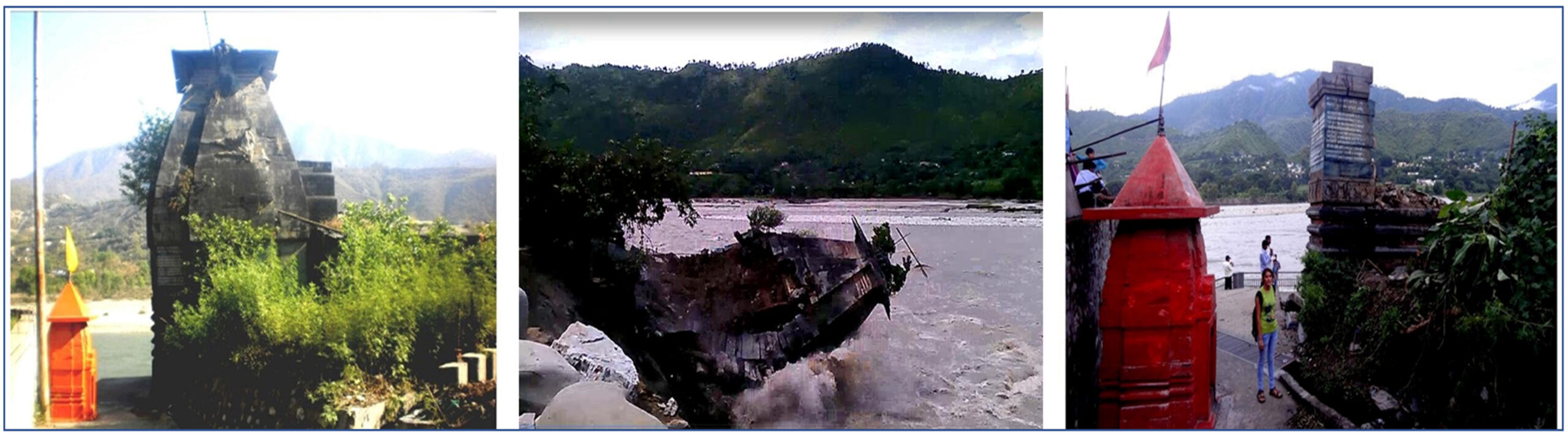
Natural Disasters: Uttarakhand lies in a fragile seismic and landslide-prone zone; therefore, natural disasters pose one of the greatest threats to its heritage. The state has witnessed countless cloudbursts, earthquakes, glacial lake outburst floods, river erosion, and landslides, (notably large events in 2013, February 7, 2021 and August 5, 2025) all of which have led to the loss of built heritage structures. Many temples located along riverbanks have been washed away, old villages and houses perched on steep slopes have collapsed, and traditional stone-and-timber buildings have suffered severe cracks and structural failures.
In the aftermath of the 2013 Kedarnath disaster, while the government undertook massive reconstruction and upliftment around the Kedarnath temple premises, no comprehensive heritage management plan emerged for other affected sites across the state.
The absence of a disaster-mitigation policy specifically addressing heritage assets remains a critical gap. Institutions like the State Disaster Management Authority (USDMA) and the Culture Department have yet to integrate cultural heritage into their risk-reduction frameworks.
However, an even greater concern arises in the aftermath of these disasters. Reconstruction efforts often prioritize speed over authenticity. Traditional materials such as stone and timber are increasingly replaced by cement and concrete, permanently altering the original character and aesthetic of Uttarakhand’s architectural heritage.
Unplanned Development: Unplanned development is an equally serious concern. Uttarakhand has a long and rich tradition of pilgrimage and spirituality, which has shaped the growth of historic towns such as Joshimath, Uttarkashi, Almora, Srinagar, Devprayag, and Pithoragarh, among others. These ancient settlements are repositories of built heritage, but rapid and unregulated construction has increasingly replaced traditional architecture. In the absence of a comprehensive heritage protection act, development continues to occur at the cost of history and heritage. This issue is not confined to lesser-known or undocumented sites, it is equally visible in prominent temple towns like Badrinath and Kedarnath, which are gradually losing their cultural and historical identity due to encroachments, unplanned expansion, and the mass commercialization of sacred landscapes.
Ignorance: The tangible heritage of Uttarakhand is the product of ingenious engineering and craftsmanship developed centuries ago. However, the growing ignorance toward heritage buildings and their traditional construction technologies has become a major cause of their deterioration. The Koti-Banal or the Sumer architectural style of Uttarakhand, now globally recognized for its seismic resilience and sustainable design, is a prime example of traditional knowledge that could greatly contribute to modern sustainable development. Yet, such wisdom remains largely unacknowledged and underutilized.
This neglect has led to the irreversible loss of many heritage structures. While some heritage properties remain under the private ownership of royal families, numerous others are managed or rather mismanaged under government control. Many ancient and medieval structures lack proper maintenance or monitoring. Restoration practices, where attempted, often compromise authenticity; the use of cement, tiles, and other modern materials has severely damaged their original fabric and architectural character.
Apart from temples managed by various religious committees and boards, archaeological sites remain among the most unprotected cultural assets of the state. Hundreds of sculptural remains, inscriptions, early medieval temples, fortifications, megaliths, and brick structures are gradually disappearing due to road widening, dam construction, and rampant encroachments.
Consequently, Uttarakhand’s heritage is being lost silently without public awareness, protest, or preservation effort. A distressing example of such loss is the restoration of the ancient temple at Koteshwar in District Rudraprayag, the only known brick temple in Uttarakhand, dated to around the 7th century CE. Its recent renovation using modern tiles and cement has permanently erased not only its original structure but also its architectural identity and the historical narrative it represented.
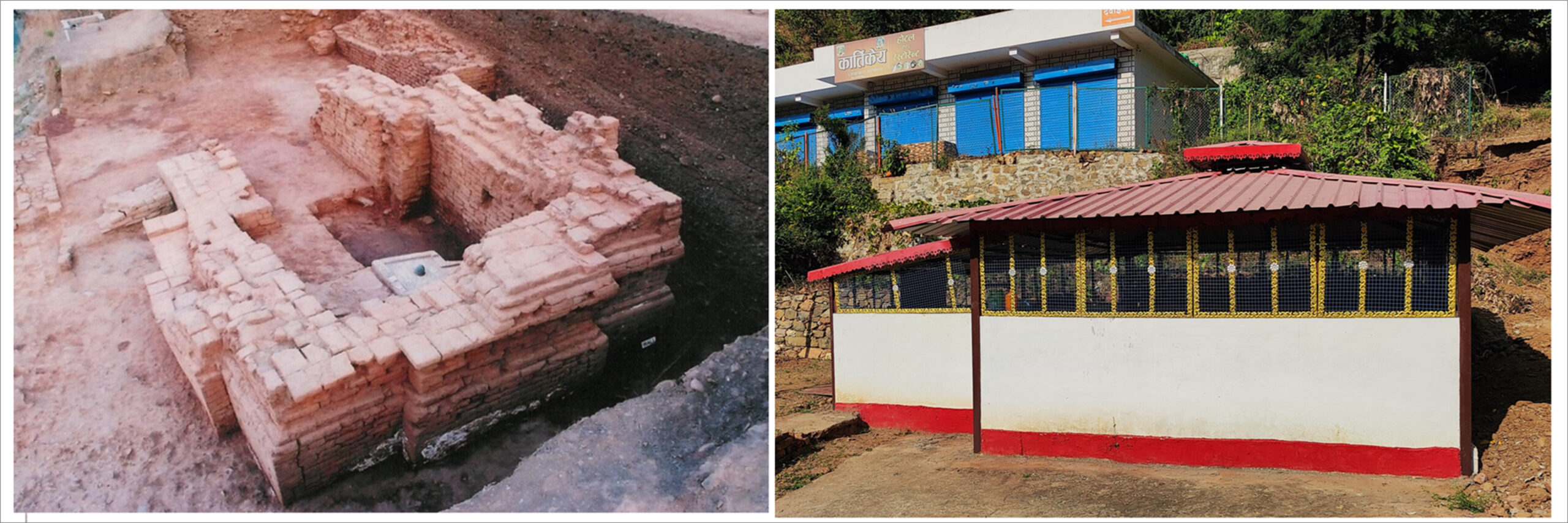
In addition to this, another major excavation during 1987-89 at Purola in Uttarkashi brought to light an ancient burnt brick structure datable to 200BCE-200CE in the form of a flying eagle, Garuda without stretched wings known as Syenchitti, a scared alter for Vedic rituals. Considering the historical significance of this, Archaeological Survey of India has listed it in ‘Centrally Protected Monuments’. Since then, no serious steps have been taken to Protect (except covering it with Tin Shed and construction of fencing wall) and develop such an important archaeological site which holds an immense potential to be developed as a significant tourist attraction, especially given its deep roots in the broader Hindu religious tradition.
Despite these challenges, there are encouraging examples that show Uttarakhand’s tangible heritage can still be saved. The conservation of several temples by the Archaeological Survey of India (ASI) demonstrates that scientific restoration using original materials can preserve the authenticity of structures for future generations.
A few NGOs and researchers have also initiated digital documentation projects for temples and other built heritage sites, often driven by personal or academic commitment. However, such isolated efforts are not enough. Uttarakhand urgently needs a structured and institutional approach for heritage documentation and conservation.
So far, the Culture Department has largely relied on ASI and local committees for conservation, with little independent capacity or budgetary autonomy. There is no institutional mechanism to assess post-disaster damage to heritage sites or to prioritize their repair. After multiple major disasters (2013, 2021, 2025), no state-level inventory or policy plan has been publicly announced to safeguard monuments and heritage properties from recurring hazards.
The first and foremost requirement is the formulation of a State Heritage Conservation Act, modelled on successful legislations from other states, such as the Rajasthan Monuments, Archaeological Sites and Antiquities Act, 1961; the Assam Ancient Monuments and Records Act, 1959; the Maharashtra Ancient Monuments and Archaeological Sites and Remains Act, 1960; the Gujarat Ancient Monuments and Archaeological Sites and Remains Act, 1965; Heritage Commission Act, 2001 of West Bengal and Jammu and Kashmir Heritage Conservation and Preservation Act, 2010.
Such a law should identify and protect temples, shrines, forts, water structures, sacred landscapes, and traditional houses whether under government or private ownership and clearly define the roles and responsibilities of the Culture Department, Public Works Department (PWD), and the Uttarakhand State Disaster Management Authority (USDMA) in their protection and post-disaster management.
It must also restrict demolition, regulate reconstruction, and impose penalties for damage or negligence. Moreover, Heritage Impact Assessment (HIA) should be made mandatory for all major infrastructure, tourism, and riverfront development projects.
Second important step is creating a comprehensive digital inventory of the state’s tangible heritage. Digital documentation of tangible heritage is the need of hour for safeguarding its temples, traditional houses, forts, and archaeological sites against natural disasters, rapid urbanization, and climate change. By capturing high-resolution images, 3D scans, GIS maps, and online archives, fragile structures and artefacts can be preserved virtually even if the originals deteriorate.
It also enhances research, helps authorities plan conservation more effectively, and enables global access to heritage resources that are otherwise located in remote mountains. Additionally, digital database also supports education, tourism, and community awareness, ensuring that the cultural identity of Uttarakhand is passed on to future generations in an accurate and accessible form.
Third step involves linking heritage conservation with disaster-safe engineering. Instead of replacing traditional structures with concrete, temples and houses should be retrofitted with sensitive structural reinforcements that enhance safety without compromising authenticity. Engineers and heritage architects must work collaboratively to ensure structural stability while retaining historical integrity.
Fourth priority should be establishing financial support mechanisms. Traditional houses are often expensive to maintain, and many temple trusts lack the funds for scientific repairs. The state could create a Heritage Maintenance Fund, develop tourism-based revenue models, and offer tax incentives for restoring heritage buildings and maintaining traditional architecture.
Finally, community involvement must remain central. Local people, who are the first responders in any disaster, are also the first custodians of heritage. Heritage education, local museums, panchayat-based monitoring, and school programs can help sustain community-led conservation.
In a state where rivers and rituals intertwine, protecting the stones ensures that the stories, songs, and faiths built upon them endure for the generations to come to cherish the heritage of Uttarakhand.
Dr. Ekta Singh is a Postdoctoral Fellow in the Department of Earth Sciences at the Indian Institute of Technology Roorkee, Uttarakhand. She is an archaeologist specializing in Himalayan archaeology, with expertise in prehistory, rock art, trans-Himalayan burial traditions and their origins, as well as ancient DNA, trade, and migration.
Dr. Nagendra S. Rawat, Assistant Professor of History and Archaeology at HNB Garhwal University, specializes in the archaeological and cultural heritage of the Central Himalaya. His research focuses on medieval forts, temple architecture, Digital Archaeology using interdisciplinary methods to understand historical landscapes and settlement patterns.
Liked this blog? We urge you to support our ongoing advocacy and research efforts by donating us online here: