In July 2026, heavy overnight rainfall created a crater in the approach road to the newly inaugurated Nanda Ki Chowki bridge over the Tons River on the Dehradun–Paonta Sahib highway, barely 16 days after the ₹16-crore structure was opened to traffic. The ensuing debate centred on construction quality and administrative accountability. Largely absent, however, was another important question: what does repeated infrastructure failure cost the environment, and who accounts for it?
Every reconstruction project consumes fresh material, requires excavation, generates transport emissions, and disturbs land. Yet these environmental costs are rarely measured. Current infrastructure planning in Uttarakhand offers no framework for tracking the cumulative ecological footprint of assets that are damaged and rebuilt multiple times.
Environmental approvals in India assess the impact of constructing a road or bridge. Forest diversion, excavation, muck disposal, and biodiversity loss are evaluated before a project begins. What they do not assess is the environmental impact of rebuilding the same asset a second or third time over its operational life. Every reconstruction following floods or landslides consumes additional cement, steel, and aggregate, disturbs new land, and generates emissions that fall outside the scope of the original environmental clearance.
This gap has become increasingly significant because much of Uttarakhand's existing infrastructure was designed for climatic conditions that no longer exist. The Himalayas are among the world's youngest and most tectonically active mountain systems, characterised by fragile slopes and highly dynamic rivers. The The Intergovernmental Panel on Climate Change's (IPCC) Sixth Assessment Report finds that mountain communities, including those in the Hindu Kush Himalaya, are already experiencing more frequent landslides and flash floods.
It also projects that flood-related damage to infrastructure will rise sharply as global warming approaches 2.0–2.5°C. The relevant policy question is therefore whether infrastructure is being designed, maintained, and upgraded for the climate conditions the state now faces, rather than those that existed when these assets were first built.
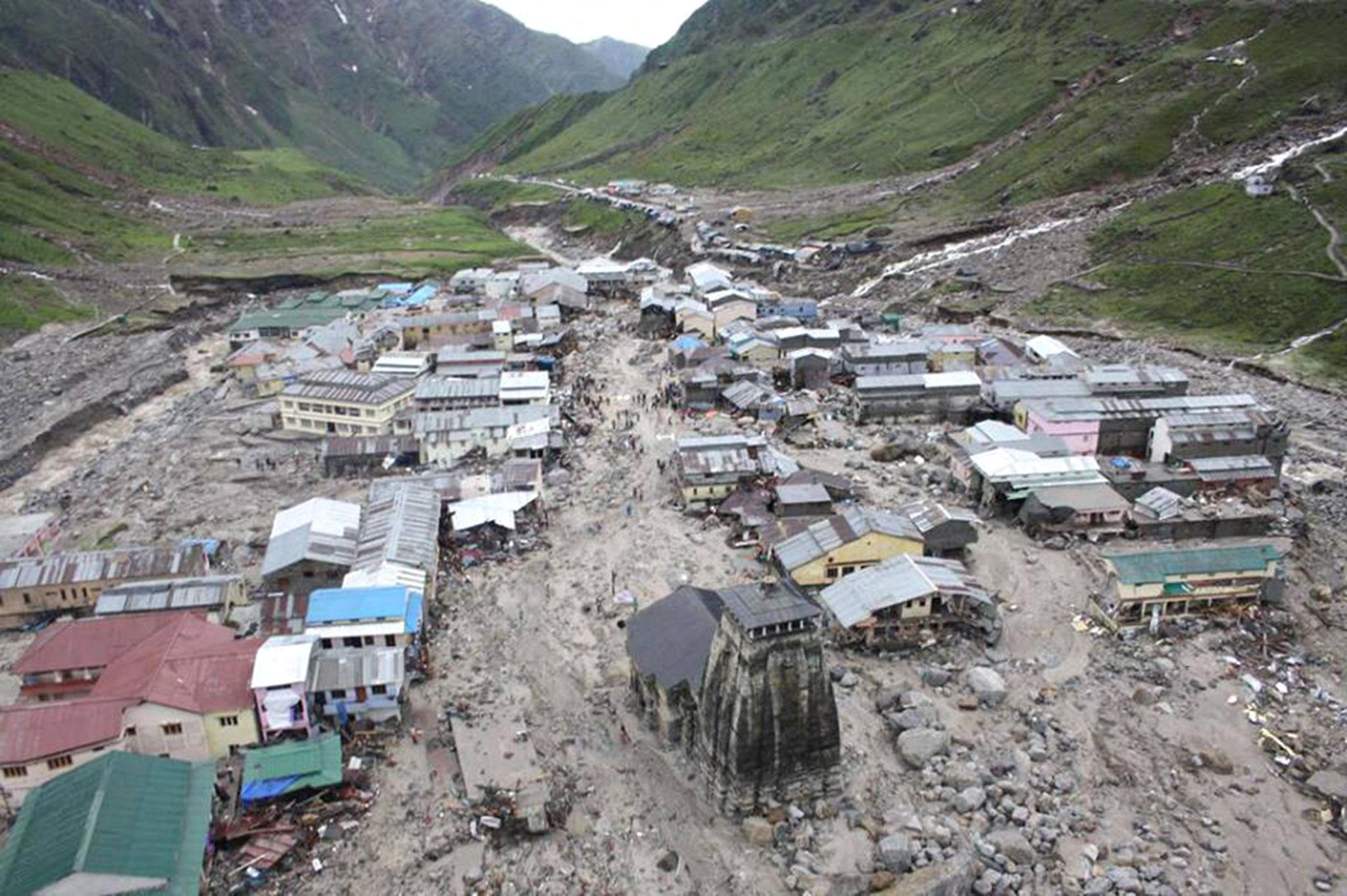
The scale of this challenge became evident after the June 2013 Kedarnath disaster. According to the Comptroller and Auditor General's (CAG) Performance Audit on Reconstruction of Infrastructure Post-2013 Disaster in Uttarakhand, the disaster damaged approximately 8,909 kilometres of roads, 85 motor bridges, and 140 bridle bridges, disrupting connectivity to nearly 4,200 villages.
The World Bank's parallel damage assessment recorded similar findings and financed the reconstruction of more than 1,500 kilometres of roads and over 80 bridges under the Uttarakhand Disaster Recovery Project. The CAG audit also identified shortcomings in planning, monitoring, fund utilisation, and quality control during reconstruction. These findings relate to governance and expenditure, but they also demonstrate that reconstruction has become a recurring component of the state's infrastructure programme rather than an exceptional response to a single disaster.
Each reconstruction cycle generates emissions and consumes materials that are typically absorbed into routine project accounting instead of being tracked over the asset's lifetime. Resurfacing, retaining-wall reconstruction, and slope excavation after damage rely on the same carbon-intensive materials as new construction, including cement, steel, and aggregate. Because environmental assessment is linked to individual sanctioned projects rather than to an infrastructure asset across its full service life, these recurring impacts are neither aggregated nor reported. Agencies routinely estimate the financial cost of reconstruction, but they rarely quantify its ecological cost.
A useful comparison comes from Switzerland's approach to bridge management. Research published in Nature Communications modelled the Swiss federal bridge network of 3,903 structures and found that strengthening bridges using ultra-high-performance fibre-reinforced cementitious composite (UHPFRC), instead of demolishing and rebuilding them, was technically feasible for more than 99 per cent of the network. The study estimated savings of 7.7 million tonnes of CO₂-equivalent emissions and 18.5 billion Swiss francs over 80 years compared with conventional replacement.
The relevance for Uttarakhand is not the specific engineering method, which depends on conditions very different from those of the Himalayas, but the broader principle. Infrastructure agencies that compare the lifecycle environmental impacts of repair and replacement make different investment decisions. Japan's post-earthquake and post-flood inspection systems reflect a similar philosophy.
Long-term resilience depends on systematic monitoring and maintenance rather than rebuilding after failure. Neither example suggests that Himalayan disasters can be prevented. The lesson is that resilience can be treated as a measurable planning objective rather than a response activated only after infrastructure has failed.
The National Highways and Infrastructure Development Corporation Limited (NHIDCL) has already undertaken slope stabilisation and landslide mitigation works on vulnerable highway stretches. The principle behind these interventions is straightforward: preventing failure is generally less expensive, both financially and environmentally, than rebuilding after collapse.
One practical reform would be to require an Environmental Reconstruction Statement for every major post-disaster reconstruction project. Alongside financial estimates, such a statement could disclose the quantity of construction materials consumed, associated carbon emissions, debris generated, additional land disturbed, and any forest diversion attributable to rebuilding, distinct from the original construction.
This would allow the environmental cost of repeated reconstruction to be compared against the upfront cost of more resilient design or preventive maintenance. It would also extend public accountability beyond the speed of reconstruction to the frequency with which reconstruction becomes necessary.
Uttarakhand cannot eliminate floods, cloudbursts, or landslides. It can, however, measure and gradually reduce the environmental cost of recovering from them. Infrastructure policy should track not only the kilometres of roads rebuilt or the number of bridges restored after each disaster, but also the number of reconstruction cycles avoided through better design, preventive maintenance, and climate-resilient planning. Until that cumulative environmental cost is measured, resilience will remain a stated intention rather than a meaningful planning criterion.
Vamsi Mohana is a Partner at Fathom Legal and a lawyer cum policy professional with ten years of experience.
Liked this blog? We urge you to support our ongoing advocacy and research efforts by donating us online here: