I have been living in Dehradun for the last fifteen years, and like most Doonites, I have crossed the Bindal River countless times.
Rising from the foothills of Mussoorie, this seasonal river flows through the heart of Dehradun before joining the Rispana to form the Suswa. Yet every time I crossed one of its bridges, I found myself asking the same question: How did people forget a river to such an extent that it became almost invisible to the city?
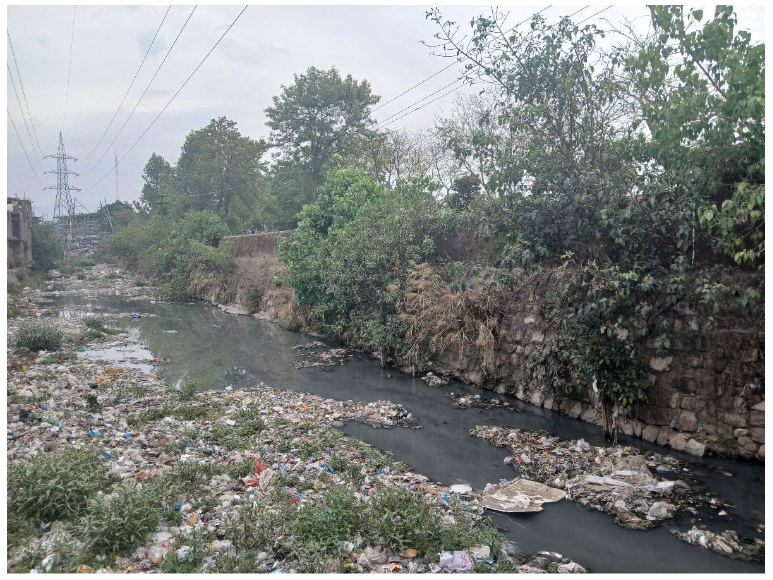
Every time I looked down from the bridge, I saw garbage clogging its channels, illegal settlements encroaching on its banks, and unchecked sewage flowing into it.
The Bindal is a seasonal river, carrying water mainly during the monsoon. During the dry months, however, it often resembles a filthy drain. Then, with the arrival of the monsoon, the same narrow, choked channel fills with polluted runoff and frequently overflows its banks.
Year after year, the scene remains almost unchanged.
Ironically, most people no longer associate the name "Bindal" with the river itself. Instead, they associate it with the bridge or the slums along its banks. For the younger generation of the city, Bindal is remembered only as a nala or a large drain. Somewhere along the way, the river has lost not only its ecological identity but also its emotional connection with the city.
As someone who works on urban water issues, my first instinct was to understand the underlying drivers of the river's degradation.
Reports and scientific studies identify rapid urbanisation, land-use change, sewage pollution, encroachment, poor waste management, degraded floodplains, altered hydrology, and fragmented governance as the key drivers of the Bindal's decline. I completely agree that all of these have played a significant role in pushing the river towards its present condition.
But these issues explain only the visible part of the story. I wanted to explore another dimension, the relationship between people and the river, which is often overlooked. I once came across a line that stayed with me:
"If you want to truly understand a river, don't just stop at its hydrology; listen to the people who live along its banks."
With this intention, our team and I began walking along the river. Very soon, we realised that while the river had one course, it carried many stories that are seldom discussed in conventional narratives.
Almost every older resident began with memories such as, "I learned to swim here," "We used to catch fish," or "Children spent their evenings on these banks." Some even recalled growing vegetables using the river's water.
In short, the Bindal was not merely a channel carrying rainwater; it was part of their neighbourhood and childhood. For a moment, it was difficult to believe they were talking about the same polluted river that today is difficult to stand beside even for a few minutes.
As we moved from upstream to downstream, the memories remained remarkably similar, but the realities changed along the way.
People in the upper stretches spoke about disappearing forests and concrete replacing open land. Residents living in the middle stretch mostly spoke of fear, fear of heavy rainfall, flooding, and losing their homes and livelihoods.
Another recurring concern was the increasing incidence of crime and drug-related activities around the bridges. Families living downstream, meanwhile, spoke about sewage, garbage, mosquitoes, and the unbearable stench.
Each conversation added another layer to my understanding. Without hesitation, I can now say that the Bindal is no longer just a polluted and declining river; it has become a reflection of the city's haphazard development.
Amid all this, another issue repeatedly surfaced during our conversations: the proposed Bindal–Rispana River Corridor project. Most people welcomed the idea, not because they expected it to become a tourist attraction, but because they hoped it would bring cleaner neighbourhoods, safer homes during the monsoon, healthier surroundings for their children, and perhaps restore some of the dignity the river once held.
At the same time, many families living close to the river also expressed concerns about rehabilitation and the possibility of losing their homes.
What stood out most during these conversations was that people were not merely complaining. They had thoughtful observations and practical suggestions. Several residents stressed the need to stop sewage from entering the river before launching beautification projects.
Others felt that solid waste management should be strengthened so that garbage no longer flows directly into the river. Many believed that protecting the remaining floodplain and preventing further encroachment should be the highest priority.
A few suggested involving schools, resident welfare associations, and local communities in regular river-cleaning drives and awareness campaigns.
These conversations strengthened our belief that people living along the river should be involved in every stage of river restoration and riverfront development, from planning to implementation, because they know the river through their lived experience.
As researchers, we often describe urban rivers as living ecosystems that connect ecology, cities, and livelihoods. Ignoring any one of these dimensions limits the long-term success of river management initiatives. If we truly want to revive rivers like the Bindal, we must begin by listening to the people who have lived with them and witnessed their transformation over the years.
Rejuvenating the Bindal is not only about cleaning a water channel or constructing a riverfront. It is about rebuilding the relationship between the city, its people, and the river before that connection is lost completely. Perhaps that is one of the biggest challenges facing Dehradun today.
One conversation with an elderly resident has stayed with me ever since. Her words captured something that no scientific report could.
She quietly said, "The river has changed, but so have we. Earlier, we lived with the river; today, we only live next to it."
Banner image :- Mr. Abhishek Sharma
Dr. Nidhi Singh is a Fellow at the Centre for Ecology Development and Research (CEDAR). Her work focuses on water resources, governance, and institutional issues in both rural and urban areas of the Indian Himalayan region.

