The idea of tribe is often framed in broad, homogenising terms, assuming shared similarities at a social level. But in reality, every tribal community has its own unique complexities that set it apart from others. Policy makers and even academics usually work within this broad definition. As a result, the realities of smaller or less visible tribes often remain overlooked.
The Raji community stands out for its unique history, distinct way of living, and uncommon sense of identity, making them very different from most other tribal groups. Classified as a Particularly Vulnerable Tribal Group (PVTG), the Rajis mainly live in the eastern part of Pithoragarh district in Uttarakhand. They were first recognised as a Scheduled Tribe in 1957 and later, in 1975, listed as a PVTG because of their extreme marginalisation. Locally, people often refer to them as Van Rawat, Rajwar, or Banraut. The Rajis are the smallest tribal group in Uttarakhand, with only about a thousand people. Once nomadic, they now mostly survive through small-scale farming and limited lumber-jacking.
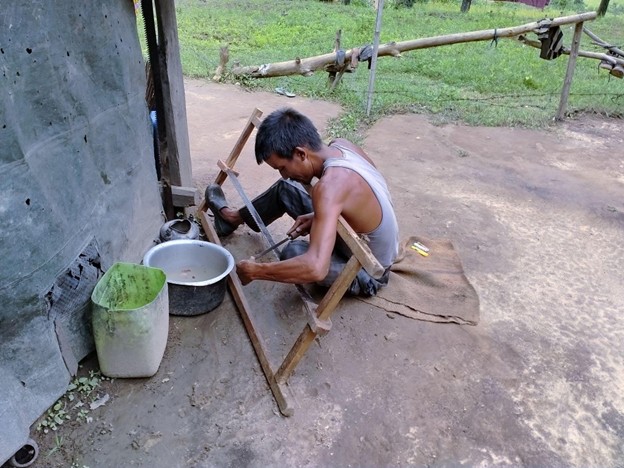
The difficult lives of the Raji community are shaped by a mix of social factors, institutions, and long-held assumptions that work against them. One of the clearest examples of this is their changing relationship with the forest. For generations, the forest was central to their identity and survival. The Rajis were closely tied to the land and were traditionally engaged in chiran (small-scale woodcutting). But over time, forestry laws and regulations transformed the forest into a restricted space. What was once their home and livelihood gradually became an area they could no longer freely access, breaking the deep bond they had with their cultural landscape.
Most Raji villages fall in areas where the authority of Van Panchayats (village forest councils) and the Forest Department overlap. This overlap, combined with the indifferent attitude of both institutions, has only deepened the Rajis’ marginalisation.
During my conversations with community members, they shared how heavily they still depend on forests, yet face constant struggles in accessing them. Collecting wood from the forest often risks arrest by officials, while even gathering forest produce through the Panchayat requires paying for a pass—something many cannot afford. As a result, their traditional woodwork, once central to their livelihood, has almost disappeared.
Still, necessity forces them to enter forests despite the risks. Many described how forest officials frequently seize their tools, leaving them with no choice but to return empty-handed. They even told me about seized tools kept at the Range office in Askot, symbolising the constant surveillance and restrictions they live under. This everyday struggle highlights how policies and institutions have turned what was once their lifeline into a site of fear and exclusion.
The Forest Rights Act (FRA) of 2006 was meant to correct historical injustices faced by tribal and forest-dwelling communities by giving them legal rights over forest land and resources. But in Uttarakhand, the Act has not been put into practice effectively. When I spoke with members of the Raji community, many said they had never even heard about the FRA or had no clear understanding of what it meant for them. This lack of awareness, combined with the indifferent attitude of forest officials, has left the Rajis unable to access the very benefits the Act was designed to provide. For a community so closely tied to forests, this failure of implementation has only deepened their struggles.
For the Raji community, even when laws like the Forest Rights Act (FRA) exist on paper, actually getting the benefits is a long and tiring struggle. One of the biggest hurdles is documentation. Many families don’t have valid tribal certificates, while others have outdated records that are no longer accepted. On top of this, the Rajis often shift their homes within the village, which makes it even harder to prove “historical residence”, a key requirement under the FRA.
Another challenge is the lack of real support from local governance. Village-level bodies are usually led by non-tribal members who show little interest in helping the Rajis with applications or paperwork. As a result, most families are left on their own to handle complicated procedures. During conversations, one person told me that they never receive any information about the FRA from their village leaders; every single form and requirement has to be managed by themselves.
This combination of poor awareness, bureaucratic hurdles, and indifference from local authorities makes the FRA feel like a distant promise rather than a real opportunity for the Raji community. Instead of empowering them, the system often ends up adding another layer of exclusion.
The idea of passive exclusion helps us understand why the Raji community continues to remain on the margins. This is not exclusion done on purpose, but it happens quietly through the way policies and programmes are designed. Most government schemes for tribal communities are based on population size. Bigger tribes, with large numbers, are able to qualify for funding and projects. But for a very small community like the Rajis, their limited population means they are often left out of these benefits.
Over time, this has created a cycle where the Rajis rarely get access to development schemes, which only deepens their struggles and keeps them excluded from opportunities that others receive more easily.
We need to rethink how the term tribe is defined, because the current way of looking at it often misses the struggles of smaller or highly marginalised communities. This narrow definition is not only used by the government, but also by non-government groups and even academics. As a result, policies and research are shaped by a broad, generalised view of tribes, while the specific realities of communities like the Rajis often remain invisible.
Bhawesh is a Senior Research Fellow and pursuing his PhD at the Tata Institute of Social Sciences, Mumbai. His MPhil dissertation focused on the exclusions faced by the Raji community.
Liked this blog? We urge you to support our ongoing advocacy and research efforts by donating us online here: