In Uttarakhand, culture does not sit behind glass in a museum. It lives in the everyday: in a courtyard where children play, in the tartness of a seasonal fruit, in a folk song passed from one generation to the next, and in a festival that marks the changing of the seasons. But much of this is quietly slipping away.
Across the state, villages have emptied. Doors remain locked for months. Fields grow wild. Many traditions survive today because a handful of elders and children refuse to let them disappear, not because systems are in place to protect them. Even festivals that once filled entire hillsides with people now feel smaller.
What were once vibrant communal celebrations have, in many places, become symbolic gestures, the form preserved but the spirit stretched thin.
And yet, something is stirring.
Local communities are pushing back. Across Uttarakhand, grassroots cultural events built around mountain food, folk traditions, local ecology, and the rhythms of the land are growing quietly but meaningfully. One of the most compelling examples is the Kāphal Festival, organised by Pandavaas as part of their Himalayan Folk Festival initiative.
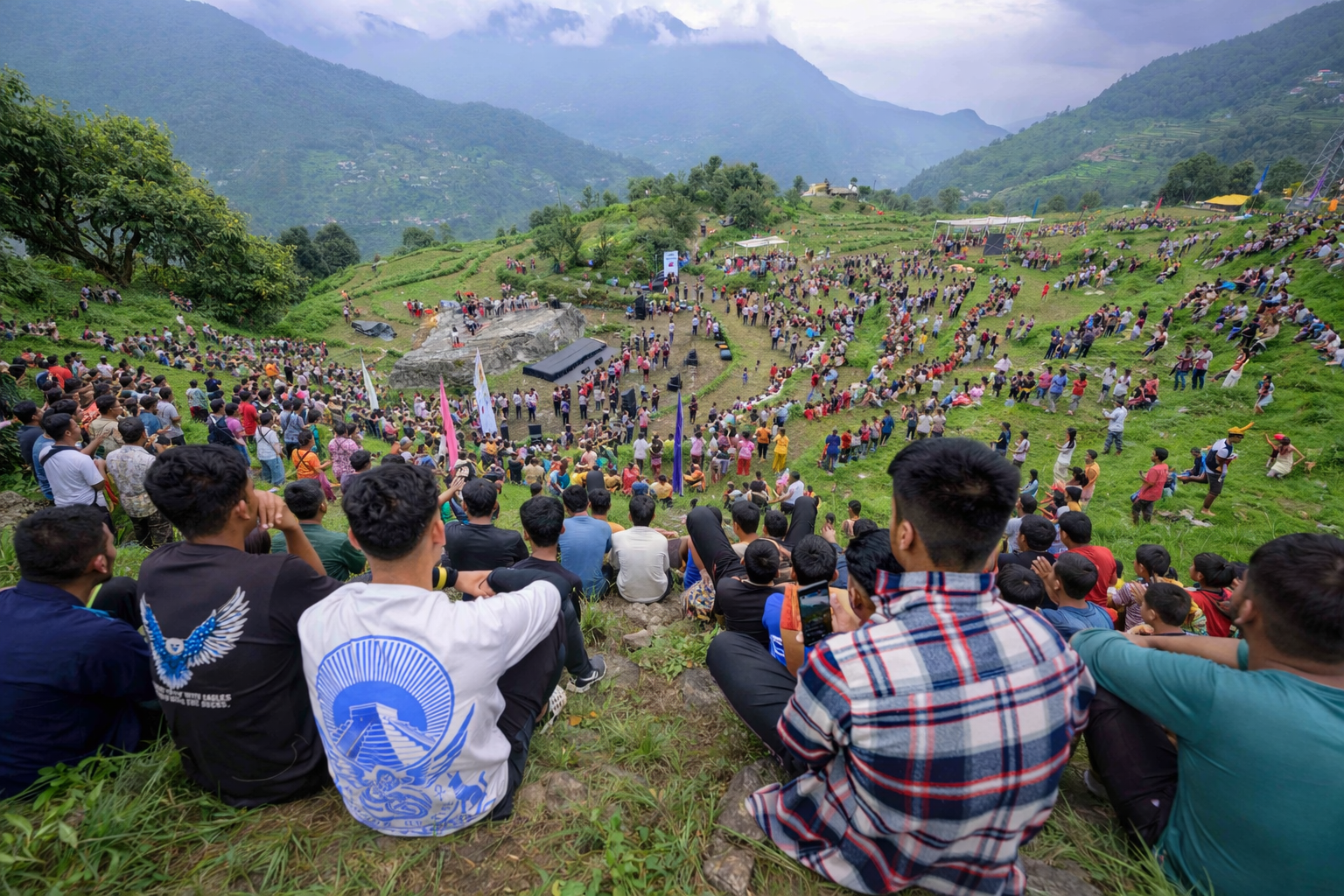
There is a range of activities the festival brings together in a single space: folk music and cultural performances, a half-marathon through forest trails, a mountain-biking challenge celebrating Himalayan eco-tourism, and photography and birdwatching workshops organised in association with Nikon, all set against the backdrop of the mountains’ rich biodiversity.
It is a rare kind of event that manages to be, at once, a cultural festival, a conservation initiative, a community training programme, and an adventure gathering. None of these elements feels bolted on. They all point in the same direction: reconnecting people, especially younger generations, with the land and the life of the hills.
This is what separates initiatives like the Kāphal Festival from the typical tourism-oriented cultural event. It is not built for an outside audience. It is built for the hills, for Sārī village, for the forests around Devriyātāl, and for the communities that live there year-round, long after visitors have returned home.
Yet this is also the quiet contradiction at the heart of Uttarakhand’s cultural moment.
Tourism campaigns celebrate “Devbhoomi culture” through glossy taglines. Yet the grassroots events that keep that culture alive, such as the Kāphal Festival, often operate on shoestring budgets and personal conviction, driven by people who wear multiple hats to sustain the effort.
Recently, Anand Mahindra posted about Phool Dei, a folk festival from the hills, calling the village children who celebrate it his “Monday motivation.” For many people across India, it was the first time they had encountered the tradition.
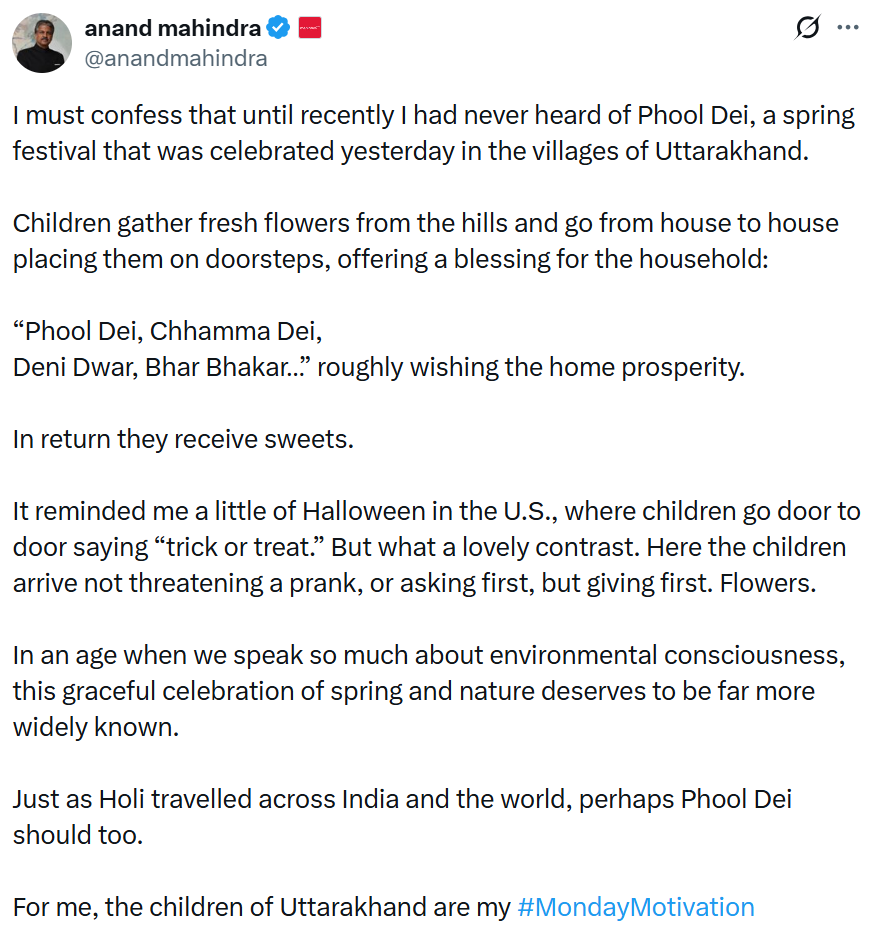
Phool Dei is observed at the beginning of Chaitra, as spring arrives in the mountains. Children collect flowers, including phyoli and buransh, and go from door to door, placing petals on doorsteps and singing blessings for each household. In return, families offer sweets, jaggery, rice, or small gifts.
It is one of those rare traditions in which children are not merely participants; they are the carriers of culture itself.
It is genuinely heartening to see such a tradition reach a national audience. Social media moments like these can spark genuine curiosity and even a sense of pride among younger people who might otherwise never have encountered these customs. But appreciation is not the same as preservation.
If Phool Dei can capture people’s imagination online, the next honest question is: what happens to the villages, the forests, the seasonal cycles, and the communities that sustain these traditions throughout the rest of the year, when no one is watching?
What happens to the people doing the quiet, unglamorous work: running zero-waste workshops with villagers long before a festival begins, organising forest runs that draw people into the hills with intention rather than indifference, and trying to keep folk music alive in places where young people are steadily leaving?
These are the efforts that deserve more than admiration from a distance. They need sustained support, basic infrastructure, and policy recognition that allows them to grow and endure. Because culture rarely vanishes overnight. It fades slowly, over the years, when the people keeping it alive feel overlooked.
The attention on Phool Dei could be more than a feel-good moment. Perhaps it can serve as a prompt to look more closely at the cultural initiatives working quietly across the hills, from a village in Sārī to a forest trail above Chopta, and ask how we can genuinely strengthen them.
Nostalgia can make us love a tradition. But only supported, empowered communities, and people with the courage to build something real in the hills, can keep it alive.
Barkha Manral is a working professional focused on policymaking and development at India Internet Research Organisation (iiro.in).
Liked this blog? We urge you to support our ongoing advocacy and research efforts by donating us online here: